
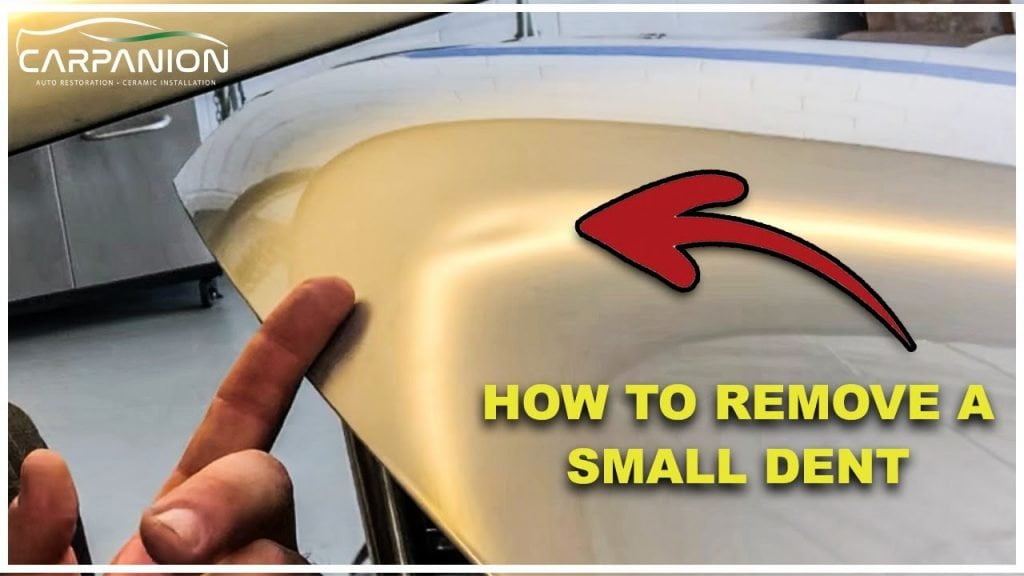
Kind of a crash course on PDR or Paintless Dent Repair. It takes time to get good at. People out there that are trying to learn or get their mind wrapped around a new skill set. This would be a good place to start.
By no means am I claiming to be the best. A lot of people out here doing this that are very good. But just to give you some basics, this is how it goes down. I’m gonna be doing some soft pulls with glue tab. Hot glue. There’s our dent right there. It’s pretty soft, not too sharp, which is a good thing. It’ll be easier to correct it without worrying about cracking the paint. A lot of times when a dent happens or something gets pushed into the metal, the metal around the dent will actually raise up a little bit, creating what they call a brow or a high spot. It’s important, in most cases imperative that you push the brow down first before you try to lift the dent back up. Otherwise, the brow acts as a reinforcement to keep the dent down.
When you go to push the dent up, you’ll notice that, because you’ll push the dent up, it’ll be flat or it’ll look smoother and then the moment you let go you’ll watch the metal just pull right back in.
We’ll do some work on this guy right here and I’ll show you guys the difference. I’m going to start by working around the edges so that I just take tension off the dent. All I’m doing is using a knockdown with a blue tip, something soft so I don’t leave any marks, and just a paddle.
I’m putting a little tension on the knockdown before I strike it, just so I get a good consistent push but not going too hard because I don’t want to make more work for myself. All I’m trying to do is just soften the brows down so I can take tension off the thing.
So what I’m doing – glue tab – glue gun. I’m gonna try not to go too crazy here. I don’t want to pull very hard. This is a soft dent. It’s imperative that you get this tab as close to the center of the dent as possible. Usually the longer you let them set up, the harder they’ll pull.
You got to be very careful to make sure that you’re not doing this over aftermarket paint. If you are be very gentle because factory paint is bonded to the vehicle better than aftermarket paint. Or let’s say if it went to a body shop and had to get re-sprayed. So if you’re doing this, you need to be careful.
Different temperatures, different glues. They all have different times and behaviors. I’m not going hard here. I just want to pull up this. You can see we have a little bit of a high spot in here. You can still see some of the leftover glue.
So it’s just a little high right here, so I’m gonna knock it down. Knock the high spot down and then I’m going to probably do a few more glue poles continuously knocking down any high spots that I might develop using the glue to raise up any low spots.
I like to start off with glue pulling if I can in most cases just because it doesn’t leave any toolmarks. A lot of times you get a lot of the dent out. I’m sure it’s the same case with a lot of PDR techs, but it’s faster If you can get a tool on it. I lucked up. There is an opening here where I can get underneath and actually physically get behind the dent. Usually when you get this close to the front of a hood, there’s a metal bracket that stops you from being able to put tools on stuff directly. It’s usually double walled. So that’s also why I was starting off with glue pull. But I lucked up. This one’s gonna be a lot easier.
Now because I have access to it. I can use a tool. I softened the high spots down, raised up the low spots with the glue as best I could.
When finishing dents, it’s important to cut it or attack it from different angles. So we’ve been working in this angle the whole time. Once you get get it looking good from one side, it’s good to switch your light up and look at it from a different side. There’s been dents where I fixed in the past, where you know you’re doing a bunch of them. You get it looking good from one angle and then you clear your light off. You put your gear up and then you pull it outside and you can still see it. You have to work 360 around the dent as much as you possibly can. Also, it helps to bring your light further away. It will also help you see imperfections. There we go.