
Window guard. You got to be careful. Sometimes manufacturers will put what’s called double-pane glass in here. If you look at the top of the glass, if you see it in two panes, or there’s a ridge in there. It’s usually double pane. I think they do that for insulation purposes.
If you run this down there to try to make room for you to slide a tool, you will break it. You’ll crack it. And it’s about the cheapest I’ve ever seen is $550. You can replace it with single pane if they’re nice about it.
So we’re gonna use a window guard, metal with felt on the back so that we don’t scratch the glass. I like having this up, man. So I’m going gentle. But I just need to make a little room. So I can drop a tool in there and fix that.
But finding your tool is huge. Once you know your tool is. You can start pushing the dent up gently. I’m making sure that I’m bouncing off of that window guard, so I’m not scratching the glass. If you’re real good you don’t have to use this, but I’m forever a student.
So the only thing with this one is the paint was damaged, so it’s not gonna be completely blemish free. But we will get that dent out. And then touch up what’s left just to help the customer.
Another important thing about doing PDR – you need to switch your light up. So we just attacked this dent from one angle. We have to change the direction because you might have it looking good from one side, but if you switch it’ll look like a totally different dent and a lot of times like it never got touched.
When I was learning there’d be a lot of times I’d fix the dent from one angle, pull it out in the sunlight, thinking it was done and I could still see it. Bring it in, change the light up, you see a totally different situation.
So I’m gonna get this from the other angle. And then what we’ll do is we’ll slide the light out, get it further away, and that’ll let us finish the dent.
So. Like I mentioned before you want to slide your light back and then get away from the dent. Look at it from a distance, because that’ll let you see any other imperfections that may not have been fixed.
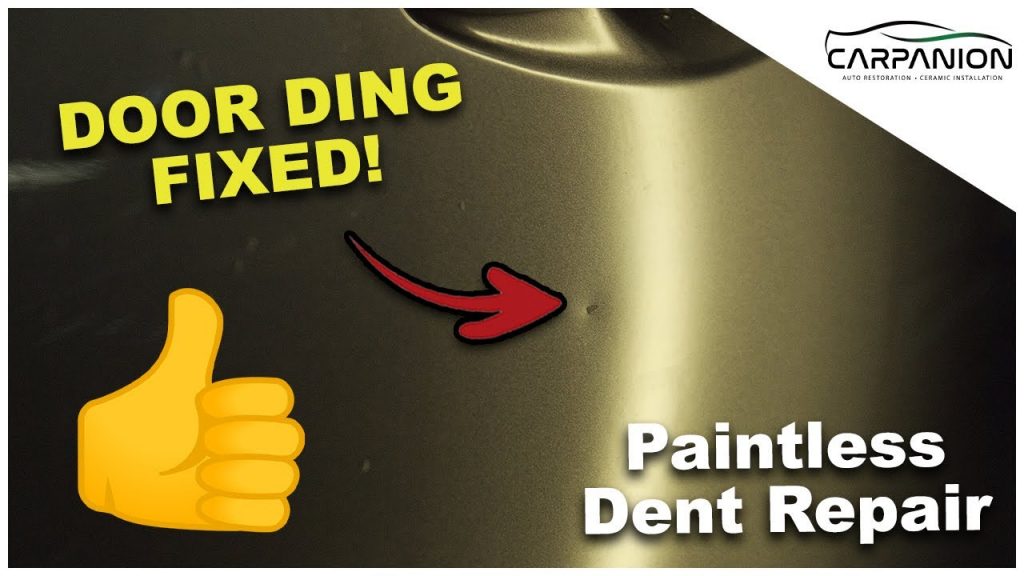
Again, this is the finished dent and to ensure that you are making it the flattest possible.